Before You Book Mother’s Day Brunch in Florida, Check the Inspection Record
Mother’s Day is one of Florida’s busiest restaurant weekends. Before you book brunch or dinner, check recent inspection history, repeated violations, and critical findings.

Mother’s Day brunch looks effortless from the table.
A full dining room. Flowers in the center. Coffee moving fast. A packed reservation list. Everybody trying to make the meal feel a little special.
In the kitchen, it is a very different kind of morning.
Holiday brunch service means eggs, dairy, fruit, pastries, cooked meats, sauces, cocktails, desserts, and nonstop table turns all hitting at once. For strong operators, that pressure is manageable. For weaker ones, it can expose exactly where the cracks already are.
That is why Mother’s Day is a smart time to check the inspection record before you book.
If you are new to reading restaurant records, start with our How It Works guide. It will make the public record much easier to interpret in a minute or two.
In the National Restaurant Association’s 2023 Mother’s Day dining survey, 40% of adults said they planned to use a restaurant for a special Mother’s Day meal. Among those dining out, 35% planned brunch, and 59% said children under 18 would be part of the dining party. In other words, this is not just another Sunday morning service. It is one of the busiest meal occasions on the calendar. (National Restaurant Association)
Why this matters more than people think
Most people choose a restaurant the normal way.
They look at photos. They skim reviews. They think about the menu, the atmosphere, maybe the drive, maybe whether they can actually get a reservation before noon.
What almost nobody sees is what the kitchen looks like when the pressure is on.
Inspection history is one of the few public signals that can help fill in that gap. It is not perfect, and it does not tell the whole story, but it does show how a restaurant performed when somebody was actually there to look closely.
CDC says 841 foodborne illness outbreaks were reported in 2017, and more than half of U.S. foodborne illness outbreaks are associated with restaurants, delis, banquet facilities, schools, and other institutions. The agency also points readers to checking restaurant inspection scores as one of the ways to reduce risk when dining out. (CDC restaurant food safety)
The part diners tend to miss
A holiday brunch does not have to go badly for the risk to go up.
The dining room can feel polished while the back of house is dealing with rushed prep, stacked tickets, poor timing, temperature drift, or somebody working when they should have stayed home.
That last point matters more than people realize.
The CDC says norovirus is the leading cause of foodborne illness outbreaks in the United States and causes about half of all outbreaks of food-related illness. It also says sick food workers can spread the virus to others and that many outbreaks happen when infected people touch or prepare food. (CDC norovirus and food workers)
So no, this is not about panic. It is about context.
Mother’s Day brunch is not automatically unsafe. It is just the kind of high-volume, high-touch service where good systems matter more — and bad ones become more expensive.
Why this holiday hits differently
Mother’s Day is usually multigenerational.
You may be booking brunch for your mom, your grandmother, your wife, your kids, or all of them at the same table. That matters because foodborne illness does not hit everybody the same way.
The FDA says the federal government estimates about 48 million foodborne illnesses, 128,000 hospitalizations, and 3,000 deaths in the United States each year. It also identifies pregnant women, older adults, young children, and people with weakened immune systems as groups at higher risk of serious illness. (FDA: People at risk of foodborne illness)
That is what makes a one-minute check feel less obsessive and more reasonable. If you want the broader consumer version of the same idea, our food safety guide breaks down the restaurant risks that matter most in plain English.
If you are choosing a restaurant for people you especially want to protect, the public record is worth a look.
What to actually look for before you reserve
You do not need to read every inspection like a lawyer. Just focus on the signals that matter most.
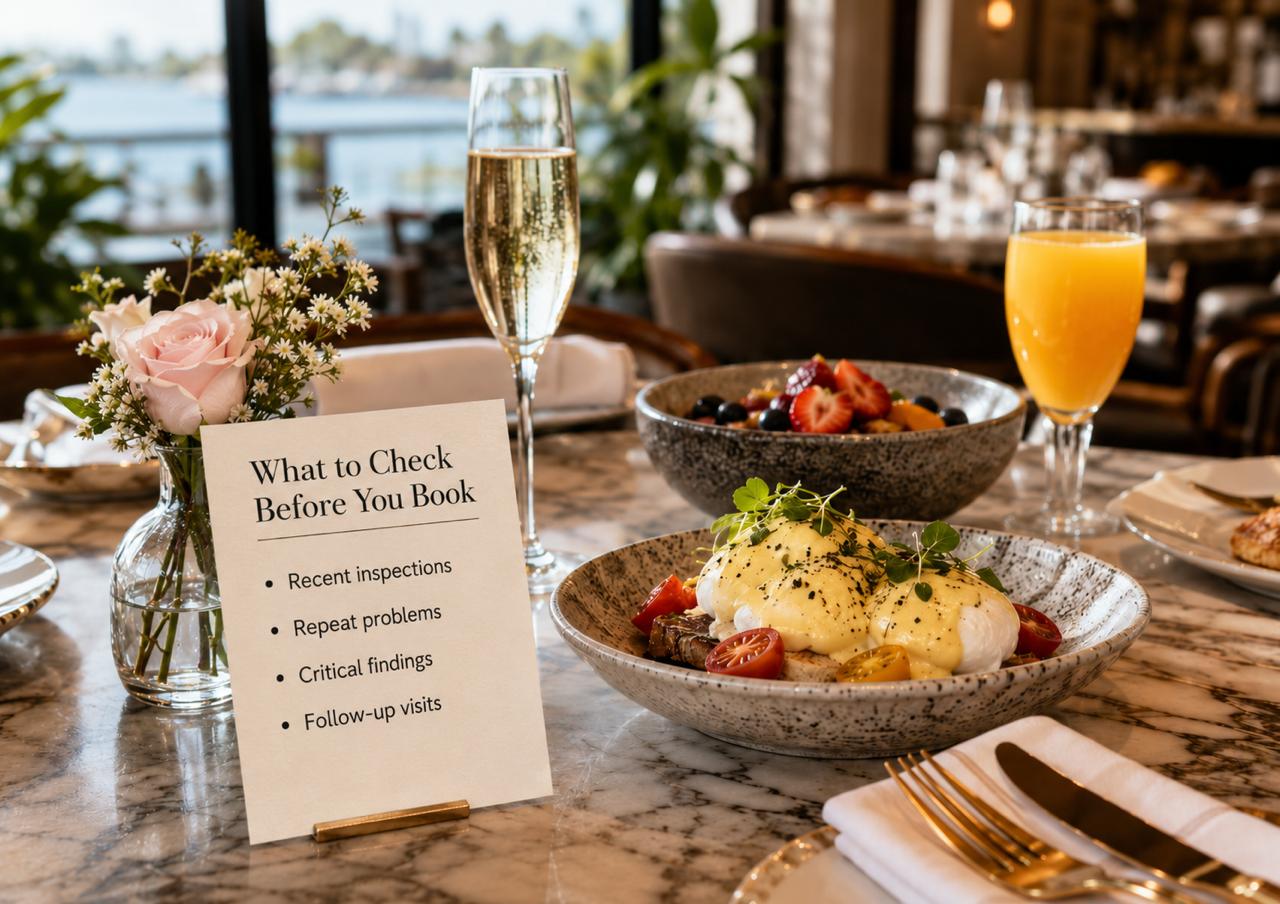
1. Recent inspection activity
Start with the latest inspections, not a random report from months ago.
Restaurants can improve quickly. They can slip quickly too. What matters most is whether the recent record looks stable, messy, or inconsistent.
2. Repeat problems
One bad inspection can happen anywhere.
What is more revealing is when the same kinds of issues keep showing up: sanitation problems, holding issues, hygiene lapses, or the same categories of findings repeating across visits.
That usually tells you more than one dramatic report ever could.
3. Critical findings
Not every violation carries the same weight.
Some are minor. Some are signs of a kitchen struggling with the basic disciplines that matter when service gets busy. The more a record points to food handling, contamination risk, or temperature control problems, the more closely it is worth reading. If you want more context on what counts as a serious problem versus a lower-risk one, see our guide to Florida restaurant inspection grades.
4. Follow-up
A rough inspection followed by strong correction tells a different story than a rough inspection followed by more of the same.
Good operators fix problems fast. The record usually makes that visible. And if you see something like an emergency closure or suspension in that history, read our guide to what an emergency order means in Florida restaurant inspections before assuming it tells the whole story.
What not to do
The worst way to use inspection data is to turn it into a permanent label.
A single bad report does not mean a restaurant is doomed forever. A single clean inspection does not mean everything is flawless either.
Inspection history works best when you read it as a pattern, not a verdict.
A place with one ugly report and strong follow-up may be less concerning than a place with a quieter but more repetitive history of the same problems. Recency matters. Repetition matters. Correction matters.
Why public records beat vibes
Mother’s Day decisions are emotional by design.
People want a place that feels beautiful. They want the reservation to feel worth the effort. They want the meal to go right. They want a table that photographs well and a brunch that feels like a win.
Inspection records do not care about any of that.
That is exactly why they are useful.
They add one unemotional layer to a decision most people make on instinct. Maybe you still choose the same restaurant. Great. At least you chose it with better information than a star rating and a plate photo.
The one-minute rule
Before you lock in Mother’s Day brunch or dinner, spend one minute checking the restaurant.
Look at the recent inspections. See whether the same issues come back. Notice whether serious findings were corrected quickly. If you are choosing between two spots, compare both.
That one minute will not guarantee a perfect meal.
But on one of the busiest restaurant weekends of the year, it can help you make a better call.
Want to check a restaurant before you book? Search any Florida restaurant →
Related reading: How It Works · Food Safety Guide · Understanding Florida Restaurant Inspection Grades
Clean data. Better choices. Know before you go.
📬 Want this in your inbox every Monday?
Florida's cleanest and dirtiest restaurants. Currently free.
Want to check a restaurant?
Search any Florida restaurant's inspection history and grade.
Search RestaurantsMore from Behind the Kitchen Door
Why Repeat Florida Restaurant Violations Matter
Learn how to read repeat Florida restaurant inspection violations, callbacks, and patterns before deciding where to eat.
Aug 9, 2026
7 Florida Restaurants With a Next-Day Clean Callback — and Rough Overall Grades
InspectFL reviewed Florida DBPR records to find seven restaurants with emergency-related inspections, 5+ high-priority findings, and a zero-finding complied callback within one day. Most still have C or F overall grades.
Jun 9, 2026
What an Emergency Order Means in Florida Restaurant Inspections
An emergency order is Florida's strongest restaurant inspection action. Here's what it actually means, what usually triggers it, and how a restaurant reopens.
Apr 30, 2026

Join the discussion
Seen this place in person? Share what stood out — cleanliness, food handling, service, or whether the inspection record matches the real experience.
Add your take in under a minute
Sign in once, then comment, reply, and save restaurants to your watchlist.
Enter the 6-digit code sent to
Helpful comments beat hot takes.
Loading comments…
No comments yet — be the first person to add useful context.