Why Repeat Florida Restaurant Violations Matter
Learn how to read repeat Florida restaurant inspection violations, callbacks, and patterns before deciding where to eat.
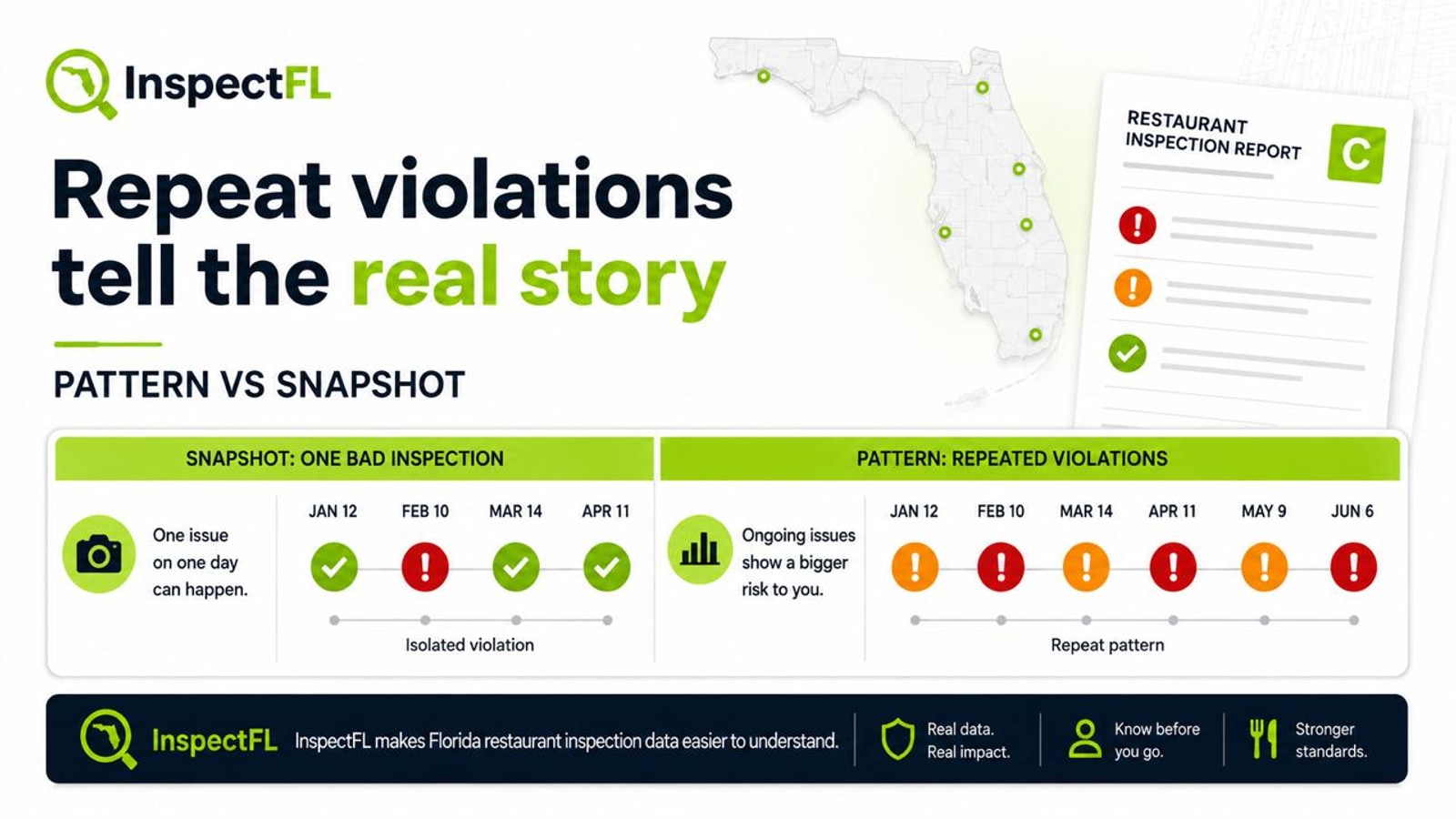
A single bad restaurant inspection can look dramatic. A long list of findings, a few high-priority items, maybe a warning or callback, and suddenly the restaurant sounds like a place nobody should ever visit again.
Sometimes that reaction is fair.
But often, the better question is not “Was this inspection bad?” It is “Has this restaurant had the same problems before?”
That is where repeat violations matter.
One bad inspection is a snapshot. Repeat violations are a pattern. And when you are deciding whether a restaurant has a one-time issue or a deeper operating problem, the pattern usually tells you more than the ugliest single report.
If you are new to the system, start with how to read Florida restaurant inspection results, what happens when a Florida restaurant fails an inspection, and understanding Florida restaurant inspection grades. This guide focuses on one specific question: why repeated findings deserve extra attention.
A repeat violation is a clue that the same control keeps breaking.
A bad inspection can happen once. The same issue appearing again is different. It can point to training gaps, weak management routines, equipment that stays broken, or a kitchen that fixes problems only long enough to pass the next visit.
Why One Bad Inspection Can Be Misleading
Restaurant inspections are real public records, but they are still snapshots from a specific visit on a specific day.
That matters because restaurants are busy, physical operations. Refrigerators fail. A new employee misses a step. A delivery shows up during prep. A dish machine may test low on sanitizer. A handwash sink may be blocked during a rush. None of that excuses a serious violation, but it does mean one inspection does not always describe the restaurant’s normal day-to-day condition.
This is why InspectFL tries to separate signal from shock value.
A single inspection can tell you what inspectors documented that day. A series of inspections can tell you whether the restaurant learns, corrects, and maintains standards after the state points something out.
That second part is usually where the trust question lives.
What Repeat Violations Usually Tell You
Repeat findings tend to matter because they suggest the restaurant had notice.
If a kitchen is cited once for a problem, management now knows it is an issue. If the same kind of problem appears again, the question changes. It is no longer just “what went wrong today?” It becomes “why did this come back?”
Repeat violations can suggest:
- a training problem that has not been fixed
- equipment that keeps failing or has not been repaired
- cleaning routines that are not being followed consistently
- food storage practices that drift back after inspection day
- management that reacts to inspections instead of building daily controls
Not every repeat is equal. A repeated basic maintenance issue is not the same as repeated high-priority food temperature problems. But repeated findings deserve a closer read because they show friction between what the restaurant is supposed to do and what inspectors keep finding.
The Repeat Problems Diners Should Watch Closely
Some repeat issues are more meaningful than others.
The most important patterns are usually the ones tied to direct food-safety controls: temperature, contamination, handwashing, sanitizer, pest activity, and follow-up compliance. These are not just paperwork problems. They are the systems that keep food safe between delivery, prep, cooking, holding, and service.
Repeated Temperature Control Problems
Temperature issues deserve serious attention because they can affect many foods at once.
One refrigerator running warm on one visit may be a mechanical failure. The same cold-holding problem across multiple inspections suggests the restaurant may not be checking temperatures often enough, may be overloading equipment, or may be relying on equipment that is not consistently holding safe temperatures.
If you see repeated cold-holding, hot-holding, or time/temperature findings, read the timeline carefully. The question is whether the restaurant corrected the condition and kept it corrected.
Repeated Cross-Contamination Findings
Raw food stored above ready-to-eat food, dirty equipment touching clean items, or utensils moving between tasks without proper cleaning can all create contamination risks.
One citation may reflect a bad setup on a specific day. Repeated citations suggest the kitchen layout, employee habits, or management checks may not be strong enough. That matters because cross-contamination problems are often preventable with routine systems: shelf order, labeled containers, clean prep flow, and clear separation between raw and ready-to-eat foods.
Repeated Handwashing or Employee Hygiene Issues
Handwashing violations can look small in a report, but they are rarely trivial.
If inspectors repeatedly find blocked handwash sinks, missing soap or towels, employees washing hands in the wrong sink, or hygiene steps being missed, that can point to a deeper culture problem. Food safety depends on repetition. If a restaurant struggles with the basic controls that should happen dozens or hundreds of times per day, the pattern matters.
Repeated Sanitizer or Food-Contact Surface Problems
Food-contact surfaces are where prep actually happens. Cutting boards, slicers, utensils, prep tables, and dish machines need to be cleaned and sanitized correctly.
A repeated sanitizer issue may mean employees are not testing sanitizer strength. A repeated dirty-equipment finding may mean cleaning routines are not detailed enough, not frequent enough, or not checked by a manager. These are the kinds of repeat findings that can make an otherwise normal-looking restaurant record more concerning.
Repeated Pest Activity
Pest findings are emotionally loaded, and for good reason. But even here, pattern matters.
A single isolated pest observation is different from repeated evidence across visits, repeated callbacks, or findings that appear in food storage, prep, or service areas. When pest-related findings repeat, you are looking less at a one-day event and more at whether the restaurant can keep the facility sealed, cleaned, monitored, and treated over time.
If the record includes emergency-level action, read our separate guide on what an emergency order means in Florida restaurant inspections.
How to Read a Restaurant Timeline
The best way to read an inspection history is not to hunt for the worst sentence and stop there. Read the sequence.
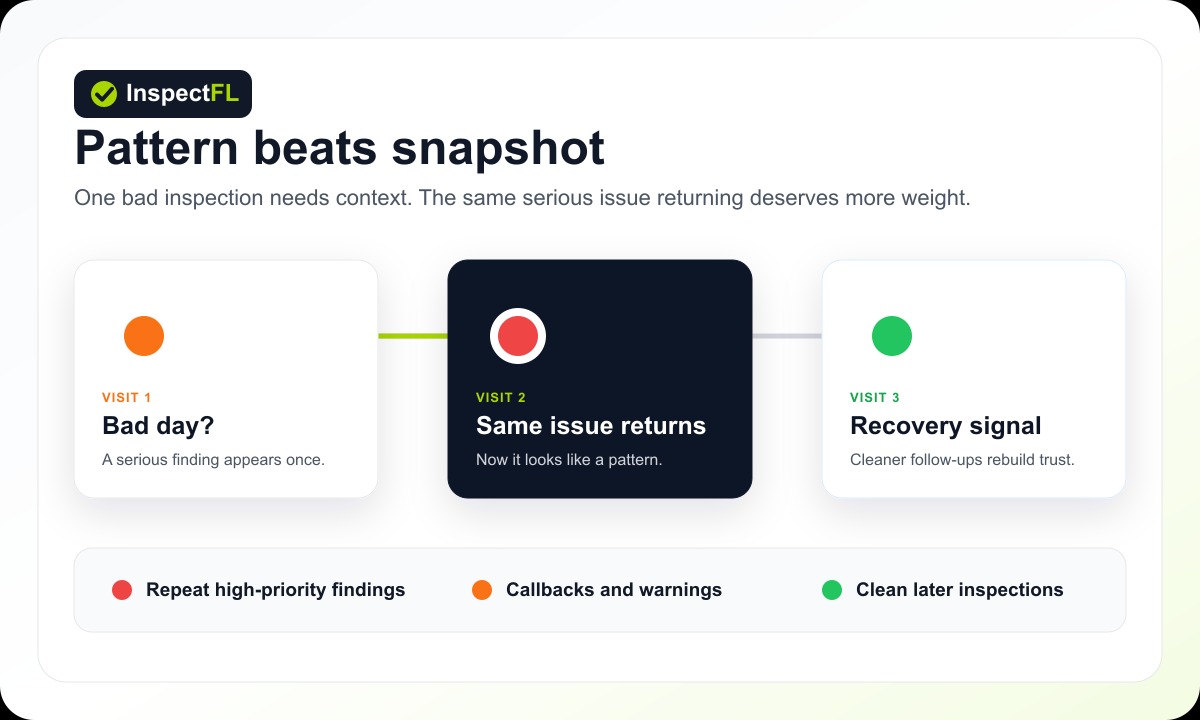
Ask five questions:
- What was the serious issue? High-priority findings usually carry more weight than basic maintenance items.
- Was it corrected on-site or sent to callback? Immediate correction is better than an unresolved finding, but repeated correction-on-site can still show a recurring weakness.
- Did it come back later? This is the core repeat-violation question.
- What happened at the callback? A complied callback is a good sign. A not-complied callback is a stronger warning.
- Are later inspections improving or getting worse? The trend matters more than the loudest single entry.
This is also why a restaurant can have an ugly inspection and still not be a place you automatically write off forever. If the next visits are cleaner and the same problems do not come back, that is a different story from a restaurant that repeats the same high-priority findings again and again.
One bad inspection asks for context. Repeated serious findings ask for caution. The more recent, severe, and repetitive the issue is, the more weight it should carry when you decide where to eat.
How Repeat Violations Affect InspectFL Scores
InspectFL Health Scores are not official DBPR ratings. They are our own 0-100 calculations built from public Florida inspection records.
The reason repeat behavior matters in scoring is simple: food safety is not only about what happened once. It is about whether a restaurant can maintain safer conditions over time.
Our scoring approach looks at several layers:
- severity of findings
- number of findings
- recency of inspections
- clean inspection behavior
- repeated or recurring problems
- whether the inspection history is improving or worsening
That does not mean a restaurant can never recover. It can. Cleaner later inspections, fewer serious findings, and stronger follow-up results can improve the picture. But repeat problems create drag because they suggest the same risk is not staying fixed.
For the methodology side, see how we built a fair restaurant grading system.
The Difference Between Repeat and Chronic
It helps to separate two levels of concern.
A repeat violation means the same or similar problem has appeared again. That is worth noticing.
A chronic pattern means the same kind of problem keeps appearing across multiple visits, sometimes across months or years, often alongside callbacks, warnings, or other serious findings. That is a different level of concern.
For diners, chronic patterns are where the inspection record becomes most useful. They show whether a restaurant is generally stable with occasional stumbles, or whether the same weak points keep resurfacing.
This is why checking only the most recent inspection can be misleading. The latest visit may be clean, but the history may show repeated serious issues. Or the latest visit may be rough, but the previous record may show years of clean results. Both situations need context.
When a Repeat Finding Should Change Your Plans
There is no perfect rule, but some combinations should make you slow down:
- repeated high-priority findings within a short period
- repeated food temperature problems
- repeated pest activity or facility sealing problems
- repeated not-complied callbacks
- repeated emergency-related findings
- the same issue appearing after the restaurant already had a warning
- a score trend moving down instead of recovering
That does not mean every repeat citation is equally alarming. It means the record deserves a fuller read before you trust the place blindly.
The goal is not panic. The goal is informed choice.
What a Good Recovery Looks Like
Restaurants can improve. The public record can show that too.
A better recovery pattern looks like this:
- A rough inspection documents specific problems.
- The restaurant corrects the issues at callback.
- Later routine inspections show fewer serious findings.
- The same high-risk issues do not keep returning.
- The broader score trend stabilizes or improves.
That is the kind of timeline that makes a bad inspection easier to put in context. The original problem still happened, but the record shows correction and maintenance afterward.
The opposite pattern is what diners should watch for: serious finding, warning, callback, temporary improvement, same serious finding again.
The Bottom Line
Do not judge a restaurant only by the worst line in its worst inspection. Also do not ignore a bad inspection just because the restaurant is popular, highly rated, or busy.
Read the pattern.
One bad inspection can be a snapshot. Repeat violations can be a signal. Chronic repeat violations can be a warning.
That is the value of a searchable inspection history: it lets you see whether a restaurant had a bad day, fixed the problem, and moved on, or whether the same risks keep coming back.
Check the pattern before you go
Use InspectFL to search any Florida restaurant, compare inspection history over time, and see whether serious findings were isolated, corrected, or repeated.
Frequently Asked Questions
What is a repeat violation in a Florida restaurant inspection?
A repeat violation is a finding that appears again after a restaurant has already been cited for the same or similar issue. InspectFL treats repeat patterns as more meaningful than one isolated bad inspection.
Is one bad restaurant inspection enough reason to avoid a restaurant?
Not always. One bad inspection can happen during a rough day, equipment failure, staffing issue, or unusual event. The smarter question is whether the same problems keep coming back and whether the restaurant corrected them on follow-up.
Why do repeat violations matter more than single violations?
Repeat violations can show that a restaurant is struggling to keep the same food-safety controls in place over time. They suggest a pattern, not just a one-day problem.
Can a restaurant improve after repeat violations?
Yes. A restaurant can improve if later inspections show cleaner results, fewer serious findings, and fewer repeated issues. The inspection timeline matters more than any single headline.
Are InspectFL scores official DBPR ratings?
No. InspectFL Health Scores are our own 0-100 calculations based on public Florida DBPR inspection records. They are not official DBPR ratings.
If you want the broader trust and methodology pages behind this article, visit how to read Florida restaurant inspection results, our editorial standards, corrections policy, and about InspectFL.
Source note: InspectFL organizes public Florida restaurant inspection records from DBPR. For the official state record on a specific establishment, use myfloridalicense.com. InspectFL Health Scores are our own analysis, not an official DBPR rating.
Related: Common high-priority violations · What happens when a restaurant fails inspection · Emergency orders explained · Understanding inspection grades
📬 Want this in your inbox every Monday?
Florida restaurant inspection highlights, strongest scores, toughest inspections, and what changed. Currently free.
Want to check a restaurant?
Search any Florida restaurant's inspection history and grade.
Search RestaurantsMore from Behind the Kitchen Door
What an Emergency Order Means in Florida Restaurant Inspections
An emergency order is Florida's strongest restaurant inspection action. Here's what it actually means, what usually triggers it, and how a restaurant reopens.
Apr 30, 2026
What Happens When a Florida Restaurant Fails an Inspection
Florida restaurants can have a bad inspection and stay open the same day. Here is how the DBPR system actually works and what diners should check next.
Apr 19, 2026
InspectFL and Life Kitchen Florida: Two Tools Helping Diners Make Educated Choices
InspectFL and Life Kitchen Florida both turn DBPR restaurant inspection records into something readable. Here's how each approach works — and why more transparency tools are good for Florida diners.
Sep 8, 2026

Join the discussion
Seen this place in person? Share what stood out — cleanliness, food handling, service, or whether the inspection record matches the real experience.
Add your take in under a minute
Sign in once, then comment, reply, and save restaurants to your watchlist.
Enter the 6-digit code sent to
Helpful comments beat hot takes.
Loading comments…
No comments yet — be the first person to add useful context.